
2000 Hall of Fame Inductees
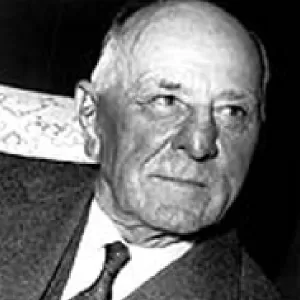
Max Hirsch
Max Hirsch
Born in Fredricksburg, Texas, Hirsch had a 70-year training career that included many major stakes victories, conditioning six champions, and a longtime stint as private trainer for King Ranch.
Hirsch first came to racing as a jockey riding at local fairs. At 12 he hopped a freight train headed for big time racing in Baltimore. This phase of his career lasted until weight gain ended his usefulness as a jockey.
Hirsch’s first major success as a trainer was the 1915 Dwyer won by Norse King, and his first champion was Sarazen, Horse of the Year 1924-25. In the 1930’s Hirsch’s record drew the attention of Robert Kleberg Jr.’s King Ranch Stable. He trained for King Ranch until his death in 1969.
Hirsch’s best known horse was Assault, the Triple Crown winner and Horse of the Year of 1946. He also won two races of the Triple Crown series with Bold Venture (1936 Kentucky Derby and Preakness Stakes)and with Middleground (1950 Kentucky Derby and Belmont Stakes). Other champions trained by Hirsch included 1946 Champion 3-Year-Old Filly Bridal Flower, 1947 Champion 3-Year-Old Filly But Why Not, 1954 Champion 3-Year-Old Male High Gun, and 1968 Champion 2-Year-Old Filly Gallant Bloom.
Hirsch passed his love of Thoroughbreds on to his children. Two of his sons, including National Horse Racing Hall of Fame member Buddy Hirsch, became trainers and his daughter Mary McLennan was one of the first women to obtain a trainer’s license. Upon his father’s death, Buddy Hirsch took over as trainer for King Ranch.
Maximilian Hirsch was inducted in the Hall of Fame in 1959.
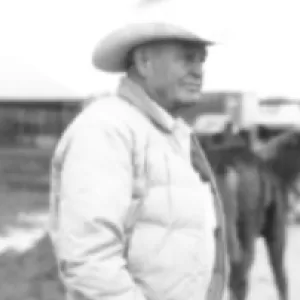
Walter Merrick
Walter Merrick
Born into a western Oklahoma farming family in 1911, Merrick began his working career in the mid-1920s as an open range cowboy and rough-string rider.
From racing to rodeo, from halter to cutting, his influence on the American Quarter Horse industry has become a part of the lore and legend that is the American West.
As a racehorse owner, Merrick’s horses have earned more than $1.5 million. As a breeder, he has bred 40 stakes winners and the earners of over $6.4 million. But, behind the numbers is a man who got his start as a teenager working on a ranch in Colorado, where he would break spoiled horses of their bad habits. In 1928 he headed home to Oklahoma, with a vow to someday have “good horses.”
He signed on with the Figure Two Ranch as a broncbuster, and promptly fell in love with a young girl hoeing cotton. Not long after Tien Shinn turned 15, the 19-year-old cowboy made her his bride. The owner of the Figure Two presented his Depression-era workers with cattle from time to time to make up for low wages, and when Merrick had a herd of 14, he branded them with that number. It has served as his mark ever since.
Merrick parlayed his 14 Ranch into an operation, which ultimately spanned four states – including Texas – and encompassed thousands of cattle and, true to his promise, only the best horses.
In 1936, he purchased Midnight Jr, and when the American Quarter Horse Association was established, the horse received number 210 in the registry. With this horse, Merrick’s racing interests grew, and he began looking for top Thoroughbred blood to cross with Midnight Jr mares.
In 1951, he convinced Sid Vail of Tucson, Arizona, that the Thoroughbred Three Bars should travel to Oklahoma where Merrick could fill his breeding book. Other great horses, which have stood at Merrick’s ranch include Tonto Bars Hank, Grey Badger II and Jet Smooth. Another profitable pairing crossed Jet Deck and Lena’s Bar to give Merrick one of his best racing prospects, Easy Jet. An equine member of the American Quarter Horse Hall of Fame, Easy Jet propelled the Merrick reputation to the top of the breeding heap.
Easy Jet’s lifetime record stands at 27 firsts, seven seconds and two thirds from 38 starts, and in 1969, his two-year-old year, he was accorded AQHA’s highest racing honor, the World Champion Racing American Quarter Horse title.
His hometown, the state of Oklahoma and AQHA all have honored Merrick for his many accomplishments. When Easy Jet won the All American Futurity in 1969, Sayre proclaimed “Walter Merrick Day” to mark the occasion, while Oklahoma State University named Merrick the 1979 Outstanding Oklahoma Horse Breeder. Two years later, he was the first horseman to be inducted into the Oklahoma Hall of Fame. That same year, AQHA named him an Honorary Vice President to mark his service to the Association. He had become a Director in 1952. Merrick served on the Show & Contest and Racing Committees. He is also a member of the AQHA Hall of Fame.
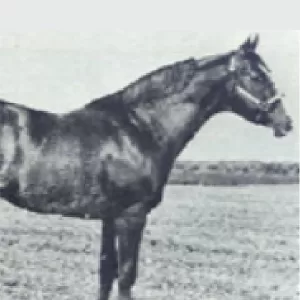
Go Man Go
Go Man Go
Foaled in 1953, Go Man Go dominated the American Quarter Horse racing scene like no other in history.
Although neither his mother nor father raced, Go Man Go quickly proved he had tremendous ability, eventually being named World Champion Racing American Quarter Horse in 1955, 1956 and 1957.
Go Man Go became the first 2-year-old to ever claim the World Champion honor. In addition, he earned multiple divisional titles, set three track records and a world record, and equaled a world record.
Go Man Go was likewise exceptional as a stallion, becoming one of the greatest sires in American Quarter Horse racing. He sired 942 foals, 775 starters, 552 winners, 6 stakes placers, 83 stakes winners, 552 Registers of Merit earners, and 7 World Champions. Go Man Go’s offspring earned over $7.5 million on the track.
Go Man Go was inducted into the American Quarter Horse Association Hall of Fame in 1990.
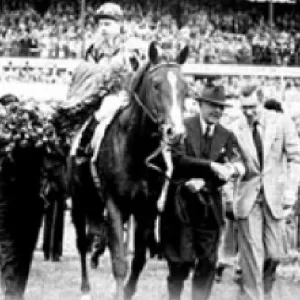
Middleground
Middleground
Bred and owned by King Ranch, this son of King Ranch’s 1936 Kentucky Derby winner Bold Venture triumphed over archrival Hill Prince in the 1950 Kentucky Derby and Belmont Stakes.
He is one of just two Texas-bred Kentucky Derby winners, with King Ranch’s Triple Crown winner Assault being the other.
Middleground was denied the Triple Crown by Hill Prince, who beat him in that and four other of their six meetings as 3-year-olds.
As a 2-year-old, Middleground won four of five starts, including the prestigious Hopeful Stakes. He was the highweighted juvenile on 1949’s Experimental Free Handicap, but with the Hopeful as his only stakes win at two, the 2-year-old championship was shared by Hill Prince and Oil Capital.
Overall, Middleground won six of 15 starts in a career cut short by injury. He finished second six times and third twice, only finishing out of the money once. In addition to the Preakness, Middleground’s stakes placings included the Wood Memorial, Withers Stakes, Derby Trial Stakes, Arlington Futurity, and Leonard Richards Stakes. He retired with total earnings of $237,725.
As a stallion, Middleground was unable to produce any offspring with his talent level. He sired 101 starters from 130 foals, with his best offspring being the stakes-winning fillies Chistosa and Resaca.
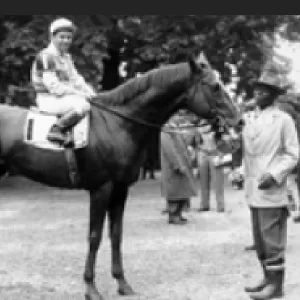
Stymie
Stymie
Foaled in 1941, Stymie was claimed for $1,500 at two by trainer Hirsch Jacobs and ultimately became the first Thoroughbred to earn $900,000.
Some considered Stymie the best bargain since Alsab, who was purchased for $700 and earned over $350,000.
Stymie was known as a stretch runner and a crowd pleaser. He won 25 races at distances from a mile to 2 1/2 miles and set or equaled three track records. Hirsch prepared Stymie to become a champion handicapper. Twice he won the Metropolitan, Saratoga Cup, Gallant Fox, Grey Lag, Aqueduct, and Sussex Handicaps.
In his most financially successful year, at six, Stymie defeated Assault and Phalanx in the International Gold Cup and won six other handicap races.
At stud Stymie was a better than average sire, producing 6% stakes winners.
Stymie was inducted in the National Horse Racing Hall of Fame in 1975.
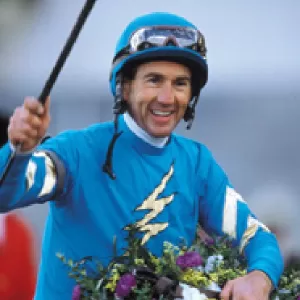
Jerry Bailey
Jerry Bailey
Born in Dallas, Texas, the son of a dentist began his career as a Quarter Horse rider at the age of 12.
His Thoroughbred racing career began in 1974, and he primarily rides the New YorkFlorida circuit.
Bailey rode Fit to Fight in his New York Handicap Triple Crown sweep in 1984 and has ridden four Breeders’ Cup Classic winners: Black Tie Affair, the 133-1 Arcangues, Concern, and Cigar. He also won two Kentucky Derbys on Sea Hero and Grindstone.
Bailey’s riding skill was amply demonstrated one weekend in 1991 when he brought Hansel home by a head in the Belmont Stakes and Meadow Star home by a nose in the Mother Goose.
More recently, Bailey has been well known for challenging the record of consecutive wins held by Citation. Bailey and Cigar equalled Citation’s record of 16 consecutive wins in 1996.
As a former President of The Jockeys’ Guild, Bailey was instrumental in lobbying for protective vests to be worn by all riders. He received the George Woolf Memorial Jockey Award in 1992 and was inducted in the National Horse Racing Hall of Fame in 1995.
Bailey has ridden 14 Breeders’ Cup race winners – more than any other jockey. He has also been honored eight times with the Eclipse Award as the nation’s outstanding jockey, including seven of the nine years from 1995 through 2003. No other jockey has ever received the Eclipse Award more than five times.
Other than Cigar, champions that have been ridden by Bailey include Pleasantly Perfect, My Flag, Soarning Softly, Macho Uno, Orientate, Six Perfections (Fr), Hansel, and Black Tie Affair (Ire).