
1999 Hall of Fame Inductees
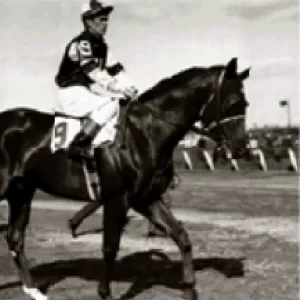
Assault
Assault
Bred in 1943 by King Ranch, Assault became America’s seventh Triple Crown winner – and the only one bred in Texas – in 1946. Assault raced for 6 years, setting earnings records and defeating older horses.
During his Triple Crown sweep, he won the Kentucky Derby by eight lengths and the Preakness by a neck.
In the final leg of the Triple Crown, Assault won the Belmont by three lengths over Natchez. He then closed out the season with impressive victories over older champions in the Pimlico Special, defeating Stymie by six lengths, and defeating Lucky Draw in the Westchester Handicap.
By the end of his 3-year-old season, Assault’s earnings eclipsed the one-season mark set in 1930. He was named Champion 3-year-old male and Horse of the Year for 1946.
At 4 Assault’s most impressive victory was his Butler Handicap win over Stymie and Gallorette. Assault carried 135 pounds in this race. During this year he also won the Brooklyn, Suburban, Grey Lag, and Dixie Handicaps.
Assault was inducted in the National Horse Racing Hall of Fame in 1964.
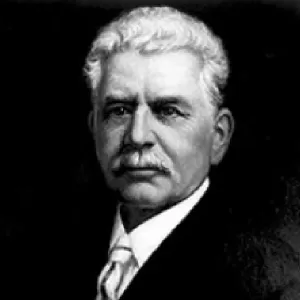
Robert Kleberg, Jr.
Robert Kleberg, Jr.
After Richard King, the founder of the famed King Ranch died in 1883, Kleberg, the firm’s former legal counsel, took over the management of the 600,000-acre ranch in Texas.
Kleberg expanded the ranch to over 1.3 million acres. Although the ranch eventually made profits from its oil, natural gas, and cotton production, it is best known for its development of the Santa Gertrudis breed of cattle. Moreover, under Kleberg’s direction, King Ranch had thriving Thoroughbred and Quarter Horse breeding operations.
On the King Ranch around 1914, Kleberg started probably the most famous breeding program in Quarter Horse history with Richard King and Caesar Kleberg. He started with a band of mainly Thoroughbred mares bought by Caesar Kleberg, and he acquired the Old Sorrel in 1918 and bred him to these mares to produce the likes of Wimpy (Champion of the Fort Worth Show, 1940), Macanudo, Peppy, Babe Grande and Charro. They became some of the most influential stallions in Quarter Horse history.
Born in 1853 in DeWitt County, Texas, Kleberg is credited as playing a large role in the development of South Texas, including setting aside the site for the town of Kingsville. He was also a leader in the fight against the Texas fever tick.
From March 1899 to March 1901, Kleberg was president of the Texas and Southwestern Cattle Raisers Association.
He was married to Alice Gertrudis King, daughter of Richard King, in 1886. They had five children, one of whom, Robert Justus Kleberg, Jr., was manager of the ranch in 1950. Kleberg died at the King Ranch headquarters on October 10, 1932.
B. F. Phillips
B. F. Phillips
Phillips was the owner of the world-renowned Phillips Ranch and was one of the premier breeders of racing Quarter horses in the United States.
Phillips, who died in 1987, is considered the most influential person in returning pari- mutual racing to Texas.
Phillips is a member of the American Quarter Horse Hall of Fame.
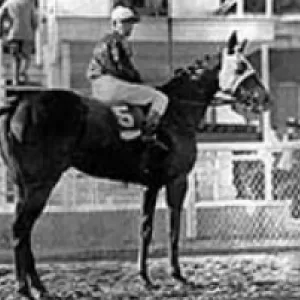
Pan Zareta
Pan Zareta
Foaled in 1910, Pan Zareta was bred in Texas and spent most of her racing career in the Midwest and Mexico participating in races of six furlongs or less.
Most of these races had purses of $300.
Still, the money grew quickly because Pan Zareta was a winner. No mare had ever won so many races—76. She also consistently carried higher weights than other mares. In 28 of her races she carried 130 pounds or more; in seven of her contests she carried 140 or more.
Pan Zareta’s winning style continued when she was brought to New York at seven. She broke Jamaica’s record for 5 1/2 furlongs and won carrying 135, 137, and 140 pounds. During her career Pan Zareta set or equalled eleven track records. In her career, Pan Zareta won 76 of 151 races, finishing second in 31 starts and third 21 times.
Pan Zareta was inducted in the National Horse Racing Hall of Fame in 1972.
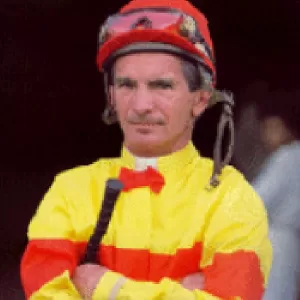
Bill Shoemaker
Bill Shoemaker
There are few words adequate to describe the career of Bill Shoemaker.
He rode from 1949 to 1990 and is one of the best jockeys of all time. Until December of 1999 he held the record for lifetime wins, a record that was held by John Longden and is now held by Lafit Pincay, Jr. Shoemaker won with nearly 22% of his mounts.
Shoemaker was born in Texas and spent most of his career on the West Coast, but repeatedly won the most important stakes of his day all over the country. He considers his ride aboard Olden Times in the 1962 San Juan Capistrano one of his finest rides.
There are not many low points in a career like Shoemaker’s, but the 1957 Kentucky Derby is one race that few will forget. Shoemaker was winning the race aboard Gallant Man when he momentarily misjudged the finish and lost to Iron Liege.
Shoemaker rode so many fine horses that he found it difficult to identify the best Thoroughbred of his career. He frequently identified three horses as his best: Swaps, early in his career, Spectacular Bid for the middle, and Ferdinand for the end of his career. Other top horses he rode include Round Table, Forego, Gallant Man, Ack Ack, John Henry, Damascus, Buckpasser, Northern Dancer, Gamely, Cicada, Sword Dancer, Hill Rise, Tom Rolfe, Cougar II, and Candy Spots.
Bill Shoemaker suffered serious injuries in 1968 and 1969 that could have ended his career, but he came back for many successful years of riding. Ironically, his most serious injury came after his retirement. In 1991 a car accident left Shoemaker paralyzed.
Bill Shoemaker has received many awards for his achievements. He was the nation’s leading jockey for 15 years and has won two Eclipse Awards and the George Woolf Memorial Jockey Award, among others. He was inducted in the National Horse Racing Hall of Fame in 1958.
Shoemaker retired from riding at age 58 and enjoyed modest success as a trainer. He also co-authored a few mystery novels.
Shoemaker died in his sleep at his suburban home near Santa Anita racetrack in California on October 12, 2003.
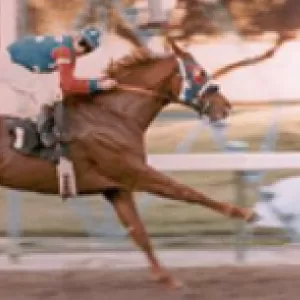
Dash For Cash
Dash For Cash
Arguably the greatest sire of racing American Quarter Horses ever, Dash For Cash was just as exceptional on the track.
He won 21 of 25 starts, which included nine stakes races, from 1975-1978. Additionally, he finished first or second in every race he entered except for one. In 1976 and 1977, Dash For Cash was Racing World Champion, Superior Racehorse in 1976, and set two track records.
Foaled in 1973, Dash For Cash’s victories included consecutive runnings of the Champion of Champions (Gr. I).
Standing stud at the Four Sixes Ranch in Guthrie, Texas, Dash For Cash sired 1,353 foals that made him a living legend. Dash For Cash’s offspring have earned more than $39 million on the track, one AQHA Supreme Championship, 880 Registers of Merit (ROM), 39 world championships and 135 stakes winners.
As a broodmare sire, Dash For Cash has been the sire of 609 dams of 2,658 performers, of which 2,624 were starters, 1,986 ROM, 1,690 winners, 198 stakes winners, 174 stakes placed, 9 champions, with earnings in excess of $44 million.